Most homeowners have a mental checklist for dryer maintenance. Clean the lint trap — check. Don’t overstuff the drum — check. But there’s one spot almost nobody thinks about, and over time it quietly becomes one of the biggest threats to both your appliance and your home’s safety: the space directly behind your dryer.
What’s Actually Happening Back There
When a dryer runs, it pushes warm, moisture-laden air out through a flexible exhaust hose that connects the back of the unit to the vent in your wall. That hose is typically made of thin aluminum or foil-style material. It bends, it stretches, and it does its job — as long as nothing is in its way.
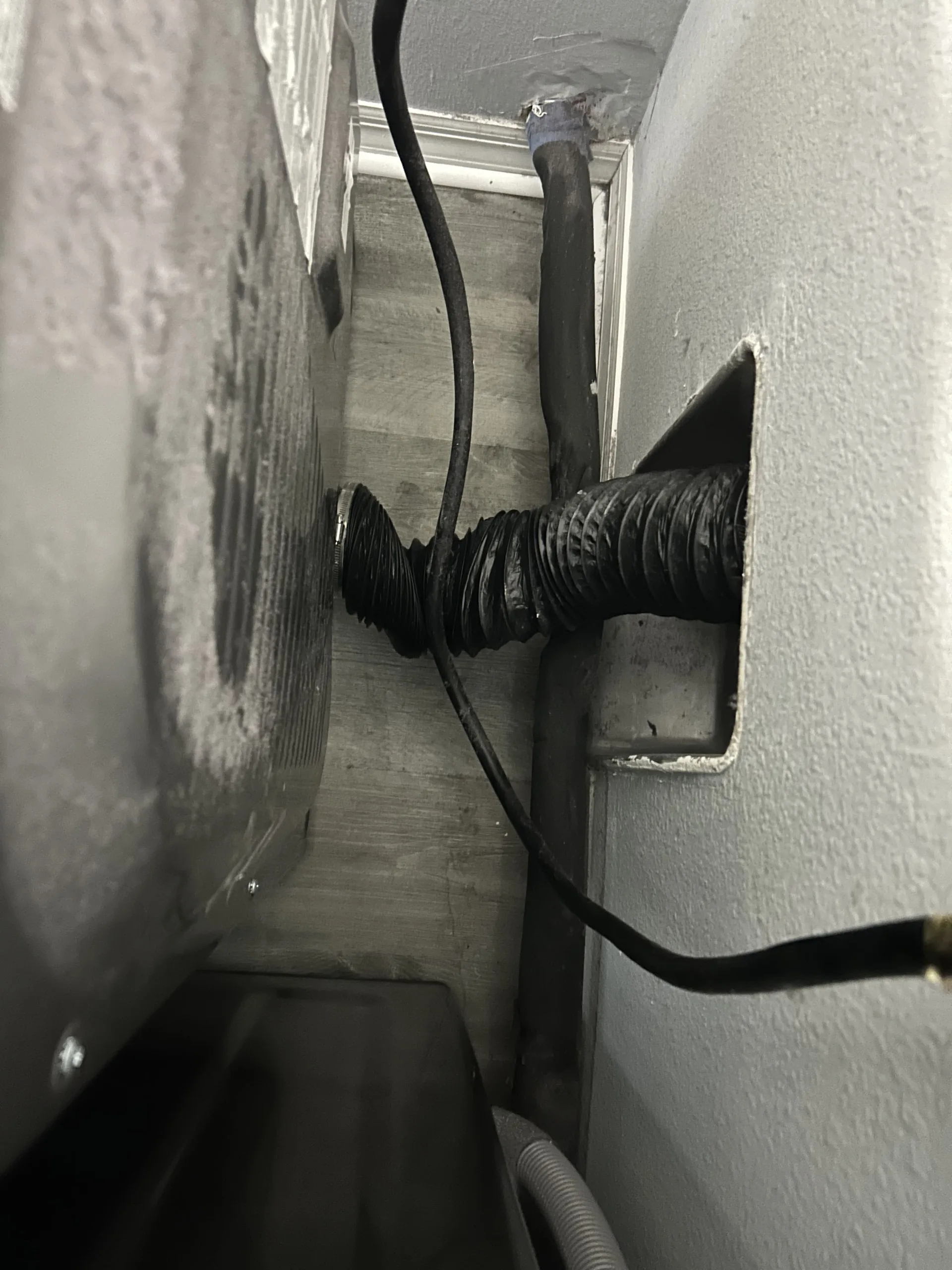
Here’s the problem. Every time you load laundry, shift something in the laundry area, or even just over the years as the dryer vibrates in place, that hose can slowly get pushed, compressed, or kinked against the wall. Most of the time, nobody notices. The dryer still runs. It still produces warm air. But what’s changed is the path that air takes on its way out.
Why a Kinked Hose Matters More Than You’d Expect
A partially crushed or kinked exhaust hose does two things that should concern any homeowner.
First, it restricts airflow. Your dryer is designed to push a specific volume of air through that hose every cycle. When the path narrows, the dryer has to work harder to move that air. Clothes take longer to dry. The motor runs under more strain than it was built for. Over months and years, that added stress shortens the life of the appliance in ways that aren’t obvious until something finally gives out.
Second — and this is the part that matters most — lint accumulates faster in areas where airflow slows down. Dryer lint is highly flammable. A restricted hose creates exactly the kind of low-flow pocket where lint collects and builds up, sometimes to a degree that surprises even experienced technicians when they inspect it.
It’s Not Just the Hose
The clearance between the back of the dryer and the wall matters too. Manufacturers typically specify several inches of space behind the unit — enough for the hose to make its bends without being forced into a tight curve. When a dryer is pushed flush against the wall, that space disappears. The hose has nowhere to go but get compressed.
This is especially common in smaller laundry areas, closets, or setups where the dryer was installed in a tight corner to save space. It’s an easy thing to overlook during installation, and it’s even easier to forget about once the dryer is in place and running.
What You Can Do Right Now
You don’t need any tools for this. Simply pull your dryer forward — gently, and making sure the power cord and any water lines have enough slack — and take a look at what’s behind it. You’re checking for a few things:
- Is the exhaust hose visibly crushed, kinked, or folded on itself?
- Does it have enough room to curve smoothly where it connects to the wall vent?
- Are there any gaps or separations where the hose connects at either end?
If the hose looks compressed or damaged, or if the space behind the dryer is too tight for the hose to sit comfortably, that’s worth addressing before your next cycle.
When It’s Time to Call Someone
Replacing a dryer exhaust hose is a relatively straightforward task, but it’s also one of those jobs where getting it right matters. A hose that’s the wrong size, a connection that isn’t sealed properly, or a vent run that’s too long can all create new problems while solving the old one. If you’re not confident in making that swap yourself, or if you’ve noticed your dryer taking longer than usual to finish a cycle, it’s a good reason to schedule a service visit. A technician can inspect the full exhaust path — including the parts inside your wall — and make sure everything is working the way it should be.
The space behind your dryer isn’t glamorous. But a quick look back there once a year could save you a longer and more expensive conversation down the road.