
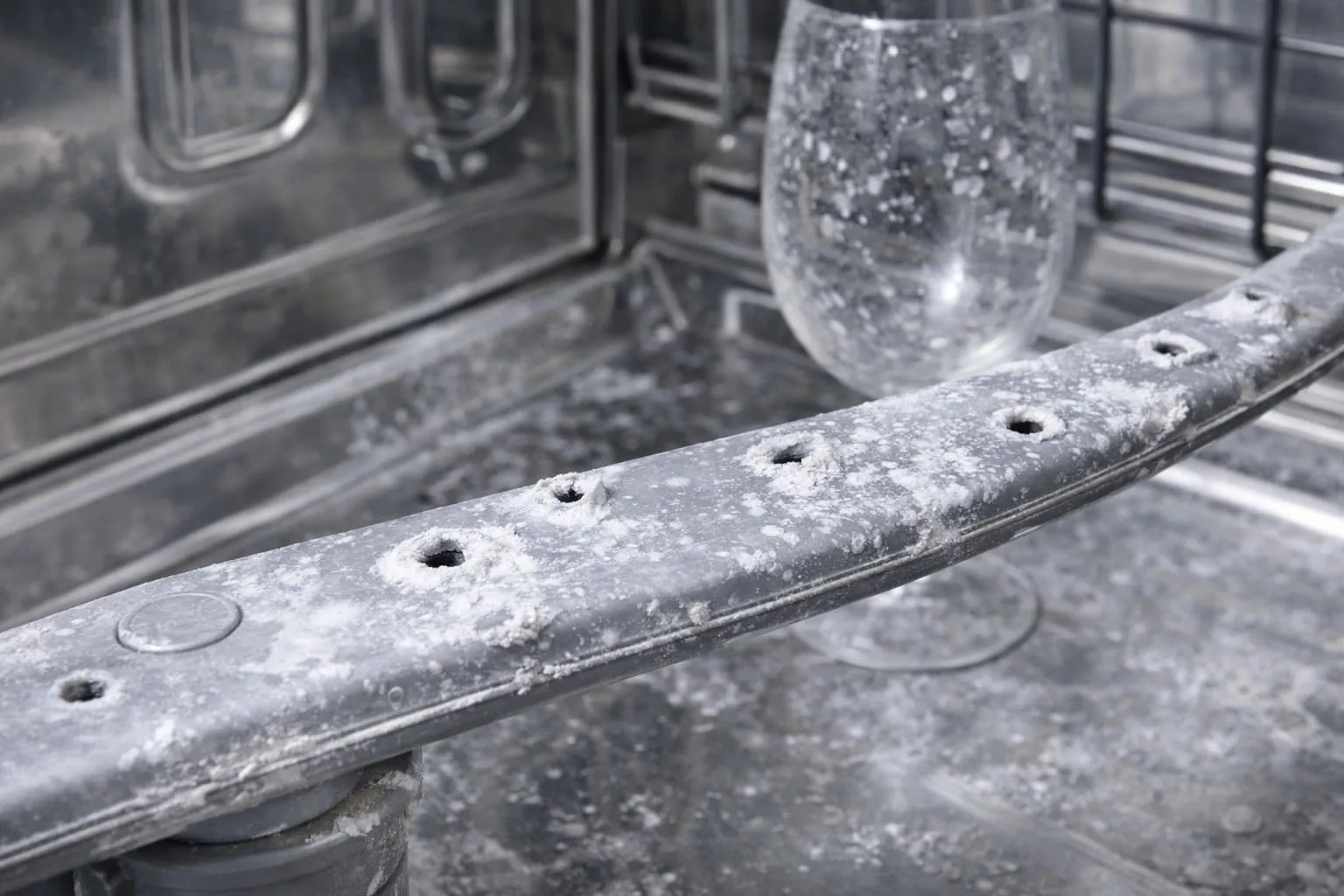
You notice a few white spots on your glasses after the dishwasher runs. It’s annoying, sure, but most people treat it as a minor inconvenience — maybe switch to a different detergent or add some rinse aid. What most people don’t realize is that those spots are just the visible sign of something happening deep inside the machine that, over time, can significantly shorten its life.
What Hard Water Actually Does Inside Your Dishwasher
Hard water contains dissolved minerals — primarily calcium and magnesium. Every time your dishwasher runs a cycle, that water passes through the machine and those minerals don’t just sit on your dishes. They gradually deposit themselves on every surface the water touches: the spray arms, the heating element, the filter, and the interior walls of the tub.
At first, the buildup is invisible. It’s a thin, chalky layer that doesn’t affect much. But mineral deposits don’t stop accumulating just because you can’t see them. Month after month, the layer grows thicker. And as it does, it starts to change how the machine works.
The Parts That Suffer Most
The spray arms are one of the first components to feel the effects. They have small holes designed to push water at a precise pressure to clean your dishes. When mineral deposits start narrowing those holes, the water distribution changes. Some dishes get washed well. Others barely get wet. Most people blame their loading technique — but the real culprit is often inside the arm itself.
- Spray arm nozzles — Mineral deposits narrow the openings, reducing water pressure and coverage across the rack.
- Heating element — Scale buildup insulates the element, forcing it to work harder and use more energy to reach the same temperature.
- Filter assembly — Fine mineral particles clog the filter over time, reducing drainage and leaving residue on dishes.
- Door seals and gaskets — Mineral deposits can cause seals to lose their grip, eventually leading to small leaks.
Why This Matters in South Florida
Water hardness varies significantly by region, and parts of South Florida are known for moderately hard water. That doesn’t mean your water is unusual — but it does mean your dishwasher is working against mineral buildup every single cycle. Over a year or two, that quiet wear adds up.
Signs You Should Pay Attention To
Most of these are easy to dismiss on their own. It’s when you notice several of them together that it’s worth taking a closer look:
- White or cloudy film on glasses, especially after a hot cycle.
- Dishes coming out with a chalky residue you can feel when you touch them.
- The dishwasher taking longer to clean than it used to.
- A faint gritty buildup visible inside the tub or on the door seal.
What You Can Actually Do About It
Running an empty cycle with a cup of white vinegar on the top rack once a month can help dissolve light mineral deposits — but it won’t reverse significant buildup that’s already formed on internal components. If your dishwasher has been running for a couple of years and you’re seeing consistent spotting or reduced performance, the buildup may already be past the point where a vinegar rinse makes a meaningful difference.
At that point, having a technician inspect the spray arms, filter, and heating element is worth considering. Catching the problem early means the difference between a simple cleaning and a part that’s already been compromised by years of mineral wear.